Multiple sclerosis and fibromyalgia both involve the nervous system, and they can cause similar symptoms, such as pain and fatigue. However, there are crucial differences. Here, learn about the distinctions, as well as symptoms, diagnostic processes, and treatments for each condition.
from Featured Health News from Medical News Today https://ift.tt/2DPkY0a
Friday, November 30, 2018
LATEST HEALTH NEWS
Itching is one type of dysesthesia, or abnormal sensation, that occurs in people with multiple sclerosis. In this article, learn about why it occurs, as well as how to get relief with home remedies and other treatments.
from Featured Health News from Medical News Today https://ift.tt/2E7crXa
from Featured Health News from Medical News Today https://ift.tt/2E7crXa
LATEST HEALTH NEWS
Prolonged exposure to light late at night causes certain cells in the eye to reset the body's internal clock and upset its rhythms, which can harm health.
from Featured Health News from Medical News Today https://ift.tt/2RnMiqi
from Featured Health News from Medical News Today https://ift.tt/2RnMiqi
LATEST HEALTH NEWS
In this month's letter, Managing Editor Honor talks mental well-being during the holiday season. How does the MNT editorial team alleviate festive stress?
from Featured Health News from Medical News Today https://ift.tt/2Shfwac
from Featured Health News from Medical News Today https://ift.tt/2Shfwac
LATEST HEALTH NEWS
A new study finds that people over 70 who have exercised regularly for decades show some physiological characteristics of much younger people.
from Featured Health News from Medical News Today https://ift.tt/2E4wvK0
from Featured Health News from Medical News Today https://ift.tt/2E4wvK0
LATEST HEALTH NEWS
New research suggests that people with healthy hearts should use exercise as 'preventive medicine' against developing heart disease and heart attacks.
from Featured Health News from Medical News Today https://ift.tt/2E2wIgP
from Featured Health News from Medical News Today https://ift.tt/2E2wIgP
LATEST HEALTH NEWS
Saline solution is easy to make at home using salt and water. Here, we look at how to make saline solution, its uses, and how to store the solution safely.
from Featured Health News from Medical News Today https://ift.tt/2rkuhxP
from Featured Health News from Medical News Today https://ift.tt/2rkuhxP
LATEST HEALTH NEWS
There are many myths surrounding the transmission of HIV. A person can only transmit HIV through certain bodily fluids, including blood and semen. HIV is not present in other bodily fluids, such as saliva, tears, or sweat, so people cannot contract HIV through kissing. Learn more here.
from Featured Health News from Medical News Today https://ift.tt/2FOVjaw
from Featured Health News from Medical News Today https://ift.tt/2FOVjaw
LATEST HEALTH NEWS
Causes of upper back pain include herniated discs, muscle overuse, osteoarthritis, and a pinched nerve. Learn more about these and other reasons for upper back pain, and how to prevent it, here.
from Featured Health News from Medical News Today https://ift.tt/2FKQ9ft
from Featured Health News from Medical News Today https://ift.tt/2FKQ9ft
LATEST HEALTH NEWS
Applying pulsed radiofrequency directly to the roots of the nerves near the spine can reduce inflammation and back pain, according to a recent study.
from Featured Health News from Medical News Today https://ift.tt/2TXSdDW
from Featured Health News from Medical News Today https://ift.tt/2TXSdDW
LATEST HEALTH NEWS
Viral load is the amount of HIV per milliliter of blood. Antiretroviral therapy aims to reduce a person’s viral load to undetectable levels, where the virus is no longer transmittable. Here, we discuss what viral load and CD4 levels mean for a person living with HIV.
from Featured Health News from Medical News Today https://ift.tt/2TXrR59
from Featured Health News from Medical News Today https://ift.tt/2TXrR59
LATEST HEALTH NEWS
People living with HIV have a higher risk of developing mouth sores. Possible causes include viral, bacterial, and fungal infections, canker sores, and dry mouth. Learn more about the causes of HIV mouth sores and how to treat and prevent them here.
from Featured Health News from Medical News Today https://ift.tt/2FQu9jH
from Featured Health News from Medical News Today https://ift.tt/2FQu9jH
LATEST HEALTH NEWS
Some people with HIV are more likely to develop shingles. In this article, we look at the factors that increase a person's risk, and cover treatments and possible complications.
from Featured Health News from Medical News Today https://ift.tt/2DSwg3z
from Featured Health News from Medical News Today https://ift.tt/2DSwg3z
LATEST HEALTH NEWS
A fever may be one of the initial symptoms of an acute HIV infection soon after exposure to the virus. In this article, learn about an HIV fever and other early symptoms.
from Featured Health News from Medical News Today https://ift.tt/2BGVNLK
from Featured Health News from Medical News Today https://ift.tt/2BGVNLK
LATEST HEALTH NEWS
Multiple sclerosis and fibromyalgia both involve the nervous system, and they can cause similar symptoms, such as pain and fatigue. However, there are crucial differences. Here, learn about the distinctions, as well as symptoms, diagnostic processes, and treatments for each condition.
from Featured Health News from Medical News Today https://ift.tt/2DPkY0a
from Featured Health News from Medical News Today https://ift.tt/2DPkY0a
LATEST HEALTH NEWS
Itching is one type of dysesthesia, or abnormal sensation, that occurs in people with multiple sclerosis. In this article, learn about why it occurs, as well as how to get relief with home remedies and other treatments.
from Featured Health News from Medical News Today https://ift.tt/2E7crXa
from Featured Health News from Medical News Today https://ift.tt/2E7crXa
LATEST HEALTH NEWS
Prolonged exposure to light late at night causes certain cells in the eye to reset the body's internal clock and upset its rhythms, which can harm health.
from Featured Health News from Medical News Today https://ift.tt/2RnMiqi
from Featured Health News from Medical News Today https://ift.tt/2RnMiqi
LATEST HEALTH NEWS
In this month's letter, Managing Editor Honor talks mental well-being during the holiday season. How does the MNT editorial team alleviate festive stress?
from Featured Health News from Medical News Today https://ift.tt/2Shfwac
from Featured Health News from Medical News Today https://ift.tt/2Shfwac
LATEST HEALTH NEWS
A new study finds that people over 70 who have exercised regularly for decades show some physiological characteristics of much younger people.
from Featured Health News from Medical News Today https://ift.tt/2E4wvK0
from Featured Health News from Medical News Today https://ift.tt/2E4wvK0
LATEST HEALTH NEWS
New research suggests that people with healthy hearts should use exercise as 'preventive medicine' against developing heart disease and heart attacks.
from Featured Health News from Medical News Today https://ift.tt/2E2wIgP
from Featured Health News from Medical News Today https://ift.tt/2E2wIgP
LATEST HEALTH NEWS
Saline solution is easy to make at home using salt and water. Here, we look at how to make saline solution, its uses, and how to store the solution safely.
from Featured Health News from Medical News Today https://ift.tt/2rkuhxP
from Featured Health News from Medical News Today https://ift.tt/2rkuhxP
LATEST HEALTH NEWS
There are many myths surrounding the transmission of HIV. A person can only transmit HIV through certain bodily fluids, including blood and semen. HIV is not present in other bodily fluids, such as saliva, tears, or sweat, so people cannot contract HIV through kissing. Learn more here.
from Featured Health News from Medical News Today https://ift.tt/2FOVjaw
from Featured Health News from Medical News Today https://ift.tt/2FOVjaw
LATEST HEALTH NEWS
Causes of upper back pain include herniated discs, muscle overuse, osteoarthritis, and a pinched nerve. Learn more about these and other reasons for upper back pain, and how to prevent it, here.
from Featured Health News from Medical News Today https://ift.tt/2FKQ9ft
from Featured Health News from Medical News Today https://ift.tt/2FKQ9ft
LATEST HEALTH NEWS
Applying pulsed radiofrequency directly to the roots of the nerves near the spine can reduce inflammation and back pain, according to a recent study.
from Featured Health News from Medical News Today https://ift.tt/2TXSdDW
from Featured Health News from Medical News Today https://ift.tt/2TXSdDW
LATEST YOGA
by Nina
I received the following comment on my post from yesterday Speaking Truth to Power About Sexual Abuse that concerned me:
"Please, can you stay away from this deluge of articles related to sex and sexual abuse. It has nothing to do with healthy aging. Westerners are fascinated by sex and sexual culture and YFHA is proving this true with so many articles devoted to this topic. A drum requires to be played on both sides, Same is true with all these stories. For every Guru that could not control their sensual impulses, there is a student that encouraged and advanced such behavior from the guru. Let the likes of Rain not act as puritans."
For such a short comment, it brought up so many issues. So rather than responding in the comment section, I thought I’d respond today in a second post. I will go through the comment point by point.
1. It has nothing to do with healthy aging.
I do not agree. First, people who are sexually abused suffer from many physical and mental health problems as a result, so it harms their health. And the stress alone created by these experiences can cause serious health problems (see About Stress: Acute vs. Chronic). Second, an abusive yoga teacher will poison the experience of practicing yoga for those he has abused as well as for those who merely witness it or hear about it. This can end up robbing yoga practitioners of their practice and commitment to yoga. Karen Rain, for example, was never able to practice yoga again after her traumatic experiences. So, the abusive teacher is essentially depriving these students of being able to even have a yoga for healthy aging practice. Finally, to practice yoga for healthy aging in a productive way (after all, equanimity is an essential part of yoga for healthy aging), students need good teachers who provide them with safe spaces within which to practice.
2. Westerners are fascinated by sex and sexual culture and YFHA is proving this true with so many articles devoted to this topic.
As far as I know, there is no country on this earth, whether east or west, north or south, where rape and sexual abuse are considered normal and acceptable behavior. In fact, these acts are considered “crimes,” not “sex.” And although in the West we have ramped up our public discussion about these problems recently, partly as a result of the #MeToo movement, these issues are also being discussed worldwide. This can only be a good thing because ignoring the issue—as it has been in the past—has not proved to be a solution to this worldwide problem.
3. A drum requires to be played on both sides, Same is true with all these stories. For every Guru that could not control their sensual impulses, there is a student that encouraged and advanced such behavior from the guru.
As a yogi, a “guru” should be able to control his sensual impulses. This is done through practicing one of the yamas, brahmacharya, which is chastity or sexual restraint. As a teacher, the yoga teacher has a higher duty—regardless of temptations and/or the possible desires of his students—to insure a safe environment for his/her students.
Of course, it is essential that yoga teachers—as well as all of us—to refrain from acting on "sensual impulses" with those who haven't explicitly consented. This is criminal behavior.
4. Let the likes of Rain not act as puritans.
Being against the molestation of yoga students by their teacher is not being anti-sex. Sexual acts of any kind when there is no consent are assault and are, in many cases, crimes. Please see Yoga and #MeToo: Toward A Culture With Zero Tolerance For Sexual Assault for more information.
5. Please, can you stay away from this deluge of articles related to sex and sexual abuse.
In my opinion, we are just in the beginning phases of an important conversation we need to have within the yoga community. If we are come up with real-world solutions to these problems, we need to hear both from women and men on this topic. And that includes right here on this blog.
P.S. Gratitude to my husband, Brad, who helped me with this post.
Subscribe to Yoga for Healthy Aging by Email ° Follow Yoga for Healthy Aging on Facebook and Twitter ° To order Yoga for Healthy Aging: A Guide to Lifelong Well-Being, go to Amazon, Shambhala, Indie Bound or your local bookstore.
For information about Nina's upcoming book signings and other activities, see Nina's Workshops, Book Signings, and Books.
from YOGA FOR HEALTHY AGING https://ift.tt/2BH4eXC
 |
| Meditation, 1936 by Rene Magritte |
"Please, can you stay away from this deluge of articles related to sex and sexual abuse. It has nothing to do with healthy aging. Westerners are fascinated by sex and sexual culture and YFHA is proving this true with so many articles devoted to this topic. A drum requires to be played on both sides, Same is true with all these stories. For every Guru that could not control their sensual impulses, there is a student that encouraged and advanced such behavior from the guru. Let the likes of Rain not act as puritans."
For such a short comment, it brought up so many issues. So rather than responding in the comment section, I thought I’d respond today in a second post. I will go through the comment point by point.
1. It has nothing to do with healthy aging.
I do not agree. First, people who are sexually abused suffer from many physical and mental health problems as a result, so it harms their health. And the stress alone created by these experiences can cause serious health problems (see About Stress: Acute vs. Chronic). Second, an abusive yoga teacher will poison the experience of practicing yoga for those he has abused as well as for those who merely witness it or hear about it. This can end up robbing yoga practitioners of their practice and commitment to yoga. Karen Rain, for example, was never able to practice yoga again after her traumatic experiences. So, the abusive teacher is essentially depriving these students of being able to even have a yoga for healthy aging practice. Finally, to practice yoga for healthy aging in a productive way (after all, equanimity is an essential part of yoga for healthy aging), students need good teachers who provide them with safe spaces within which to practice.
2. Westerners are fascinated by sex and sexual culture and YFHA is proving this true with so many articles devoted to this topic.
As far as I know, there is no country on this earth, whether east or west, north or south, where rape and sexual abuse are considered normal and acceptable behavior. In fact, these acts are considered “crimes,” not “sex.” And although in the West we have ramped up our public discussion about these problems recently, partly as a result of the #MeToo movement, these issues are also being discussed worldwide. This can only be a good thing because ignoring the issue—as it has been in the past—has not proved to be a solution to this worldwide problem.
3. A drum requires to be played on both sides, Same is true with all these stories. For every Guru that could not control their sensual impulses, there is a student that encouraged and advanced such behavior from the guru.
As a yogi, a “guru” should be able to control his sensual impulses. This is done through practicing one of the yamas, brahmacharya, which is chastity or sexual restraint. As a teacher, the yoga teacher has a higher duty—regardless of temptations and/or the possible desires of his students—to insure a safe environment for his/her students.
Of course, it is essential that yoga teachers—as well as all of us—to refrain from acting on "sensual impulses" with those who haven't explicitly consented. This is criminal behavior.
4. Let the likes of Rain not act as puritans.
Being against the molestation of yoga students by their teacher is not being anti-sex. Sexual acts of any kind when there is no consent are assault and are, in many cases, crimes. Please see Yoga and #MeToo: Toward A Culture With Zero Tolerance For Sexual Assault for more information.
5. Please, can you stay away from this deluge of articles related to sex and sexual abuse.
In my opinion, we are just in the beginning phases of an important conversation we need to have within the yoga community. If we are come up with real-world solutions to these problems, we need to hear both from women and men on this topic. And that includes right here on this blog.
P.S. Gratitude to my husband, Brad, who helped me with this post.
Subscribe to Yoga for Healthy Aging by Email ° Follow Yoga for Healthy Aging on Facebook and Twitter ° To order Yoga for Healthy Aging: A Guide to Lifelong Well-Being, go to Amazon, Shambhala, Indie Bound or your local bookstore.
For information about Nina's upcoming book signings and other activities, see Nina's Workshops, Book Signings, and Books.
from YOGA FOR HEALTHY AGING https://ift.tt/2BH4eXC
LATEST FITNESS
This post is sponsored by Nature’s Way.
With kids in school, we want to keep our family healthy during the winter season. I think of winter as the “eat more sugar, sleep less, experience more stress, and hide inside” season. These are some of the things that I try to remain mindful of as we head into the colder months.
As far as nutrients go, it can be challenging to eat a vegetable when you’re surrounded by holiday cookie platters. I look for ways to get in as much produce and nutrients as possible -soups and smoothies are convenient ways and the girls love them – and we consistently take our multivitamins and elderberry.
Some of the other things that I try to do to support our immune systems:
– Wash our hands… A LOT. I’m the weirdo who always has a hand sanitizer spray in her purse and in the car. I just have to say “hands” and the girls put their hands out to be sprayed (and roll their eyes a little. Don’t care).

When we’re home, we use soap and water to wash our hands frequently, and we’re even more diligent during the winter.

– Get outside. Vitamin D can help support the immune system, and we can naturally get less during the winter months. Even when it’s a little chilly, we bundle up and get outside every day. Whether we’re chasing each other, playing freeze dance, or taking the dogs for a walk, I think time outside is important for everyone’s sanity and happiness.

– The wellness shot aka the lemon garlic shot.
The second any of us start to feel a cold coming on, the wellness shot happens. This is a friend from the San Diego barre studio’s recipe and I’ve been using it for years now. The whole family is on board, even the Pilot who stomps around muttering to himself after he takes one. P even gets a baby wellness shot and she chugs it like a champion. So proud.
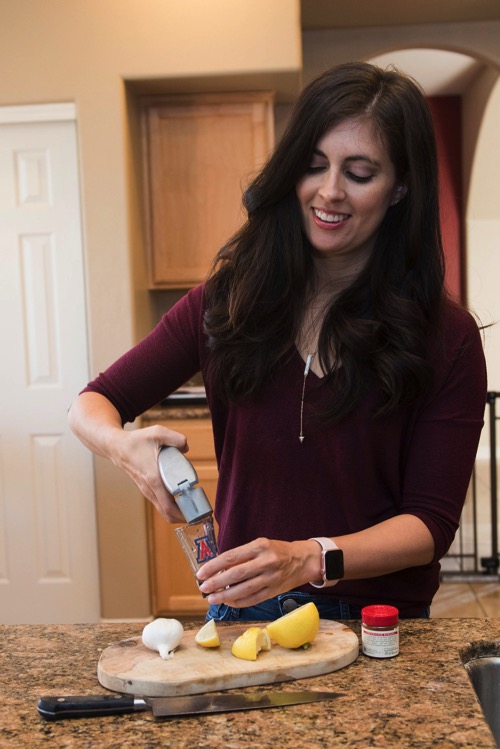
Here’s the recipe if you want to give it a try!
Juice of 1/2 lemon
1 clove of minced garlic
A little cayenne pepper on top
Take it like a shot! I’ll do these max twice a day when I start to feel a little under the weather
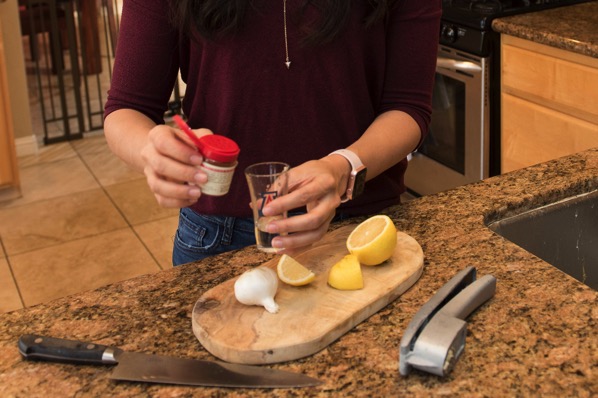
– Try to get quality sleep. So much magic happens when we sleep, and it’s the body’s chance to repair, protect, and heal itself. Even with so much going on during this busy time of year, I try to make sleep a priority.
– Reishi! This is one of my all-time favorite supplements. Reishi is a beneficial mushroom, and I think it’s really helped keep my immune system healthy*.
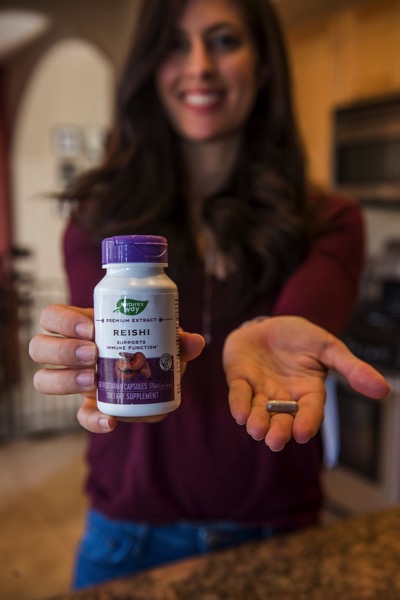
I also love that this Nature’s Way supplements doesn’t contain any artificial colors, wheat, soy, corn, gluten, dairy products, or preservatives. (As always, check with a doctor before adding any supplements to your routine.)
So, tell me friends: how do you support your immune system during the winter? Any favorite habits or remedies?
xo
Gina
*These statements have not been evaluated by the FDA. These products are not intended to diagnose, treat, cure, or prevent any disease.
The post Immune system boosters appeared first on The Fitnessista.
from The Fitnessista https://ift.tt/2G0jnrd
LATEST FITNESS
This post is sponsored by Nature’s Way.
With kids in school, we want to keep our family healthy during the winter season. I think of winter as the “eat more sugar, sleep less, experience more stress, and hide inside” season. These are some of the things that I try to remain mindful of as we head into the colder months.
As far as nutrients go, it can be challenging to eat a vegetable when you’re surrounded by holiday cookie platters. I look for ways to get in as much produce and nutrients as possible -soups and smoothies are convenient ways and the girls love them – and we consistently take our multivitamins and elderberry.
Some of the other things that I try to do to support our immune systems:
– Wash our hands… A LOT. I’m the weirdo who always has a hand sanitizer spray in her purse and in the car. I just have to say “hands” and the girls put their hands out to be sprayed (and roll their eyes a little. Don’t care).
When we’re home, we use soap and water to wash our hands frequently, and we’re even more diligent during the winter.
– Get outside. Vitamin D can help support the immune system, and we can naturally get less during the winter months. Even when it’s a little chilly, we bundle up and get outside every day. Whether we’re chasing each other, playing freeze dance, or taking the dogs for a walk, I think time outside is important for everyone’s sanity and happiness.
– The wellness shot aka the lemon garlic shot.
The second any of us start to feel a cold coming on, the wellness shot happens. This is a friend from the San Diego barre studio’s recipe and I’ve been using it for years now. The whole family is on board, even the Pilot who stomps around muttering to himself after he takes one. P even gets a baby wellness shot and she chugs it like a champion. So proud.
Here’s the recipe if you want to give it a try!
Juice of 1/2 lemon
1 clove of minced garlic
A little cayenne pepper on top
Take it like a shot! I’ll do these max twice a day when I start to feel a little under the weather
– Try to get quality sleep. So much magic happens when we sleep, and it’s the body’s chance to repair, protect, and heal itself. Even with so much going on during this busy time of year, I try to make sleep a priority.
– Reishi! This is one of my all-time favorite supplements. Reishi is a beneficial mushroom, and I think it’s really helped keep my immune system healthy*.
I also love that this Nature’s Way supplements doesn’t contain any artificial colors, wheat, soy, corn, gluten, dairy products, or preservatives. (As always, check with a doctor before adding any supplements to your routine.)
So, tell me friends: how do you support your immune system during the winter? Any favorite habits or remedies?
xo
Gina
*These statements have not been evaluated by the FDA. These products are not intended to diagnose, treat, cure, or prevent any disease.
The post Immune system boosters appeared first on The Fitnessista.
from The Fitnessista https://ift.tt/2G0jnrd
LATEST Heart disease
A new study finds that people over 70 who have exercised regularly for decades show some physiological characteristics of much younger people.
from Cardiovascular / Cardiology News From Medical News Today https://ift.tt/2E4wvK0
from Cardiovascular / Cardiology News From Medical News Today https://ift.tt/2E4wvK0
LATEST Heart disease
New research suggests that people with healthy hearts should use exercise as 'preventive medicine' against developing heart disease and heart attacks.
from Cardiovascular / Cardiology News From Medical News Today https://ift.tt/2E2wIgP
from Cardiovascular / Cardiology News From Medical News Today https://ift.tt/2E2wIgP
LATEST HEALTH NEWS
 Adoptive cell transfer (ACT) is the new cancer immunotherapy that involves separating T cells from cancer patients which are capable of targeting their


from Latest Drug News https://ift.tt/2QpNhck
LATEST Alzheimer’sDisease and other Dementias NEWS
As the older population of the United States grows, the prevalence of dementia also rises. A new paper discusses dementia and gun ownership.
from Alzheimer's / Dementia News From Medical News Today https://ift.tt/2rdmQs8
from Alzheimer's / Dementia News From Medical News Today https://ift.tt/2rdmQs8
LATEST PSYCHOLOGY
Infections can lurk at the nail salon. Find out how to protect yourself.
from Psychology Today https://ift.tt/2BHUBHO
from Psychology Today https://ift.tt/2BHUBHO
LATEST PSYCHOLOGY
Gratitude may be the key to achieving your goals.
from Psychology Today https://ift.tt/2Rqz7EY
from Psychology Today https://ift.tt/2Rqz7EY
LATEST PSYCHOLOGY
Confused about why your child doesn't respond to your efforts to help? Changing this one word may go a long way.
from Psychology Today https://ift.tt/2TYEE7d
from Psychology Today https://ift.tt/2TYEE7d
LATEST PSYCHOLOGY
Metaphors and similes can be used to interpret the patient's repetitive feelings and behavior in a poignant way that strengthens the observing ego.
from Psychology Today https://ift.tt/2PZIxum
from Psychology Today https://ift.tt/2PZIxum
LATEST PSYCHOLOGY
Advice is in the eye of the beholder. How to give advice that others will listen.
from Psychology Today https://ift.tt/2P8lf07
from Psychology Today https://ift.tt/2P8lf07
LATEST PSYCHOLOGY
Is it always good to be generous and giving?Is selfish always bad? If not, how can you decide which way is right?
from Psychology Today https://ift.tt/2DW7xf5
from Psychology Today https://ift.tt/2DW7xf5
LATEST PSYCHOLOGY
Off The Straight And Narrow: As a straight parent, I have no idea what I'm doing as I navigate the world of dating, sex, and love with my bisexual teenage daughter!
from Psychology Today https://ift.tt/2TUoPi2
from Psychology Today https://ift.tt/2TUoPi2
LATEST PSYCHOLOGY
Have you ever been trapped in worry about what you should be doing for your kids? This clear 3-Step method can change all of that.
from Psychology Today https://ift.tt/2reRhhz
from Psychology Today https://ift.tt/2reRhhz
LATEST PSYCHOLOGY
Bother is generated by conflict, so solving the conflict will help to unbother your mind.
from Psychology Today https://ift.tt/2FLLKJd
from Psychology Today https://ift.tt/2FLLKJd
LATEST PSYCHOLOGY
You're not just wasting time on entertainment if you're using it right. Here are some ideas for making it therapeutic.
from Psychology Today https://ift.tt/2QmGoIL
from Psychology Today https://ift.tt/2QmGoIL
LATEST PSYCHOLOGY
Despite ongoing controversy and criticism of her methodology, Prof Littman's study of Rapid Onset Gender Dysphoria deserves to be considered.
from Psychology Today https://ift.tt/2TWynJs
from Psychology Today https://ift.tt/2TWynJs
LATEST PSYCHOLOGY
Holidays getting your down? Here are a few ideas to help you cope.
from Psychology Today https://ift.tt/2AC9GZO
from Psychology Today https://ift.tt/2AC9GZO
LATEST PSYCHOLOGY
Pregnancy can be a time of emotional change for dads as well as moms.
from Psychology Today https://ift.tt/2TVMKNY
from Psychology Today https://ift.tt/2TVMKNY
LATEST PSYCHOLOGY
How it relates to the information-processing function of the brain.
from Psychology Today https://ift.tt/2rdVy4Q
from Psychology Today https://ift.tt/2rdVy4Q
LATEST PSYCHOLOGY
The road out of a painful childhood is filled with obstacles, many of them assumptions we learned to make about the world and people when we were young.
from Psychology Today https://ift.tt/2reB5Ng
from Psychology Today https://ift.tt/2reB5Ng
LATEST PSYCHOLOGY
When we grieve, we may dread the thought of the holidays. But others may find it a welcome diversion.
from Psychology Today https://ift.tt/2E4MSGb
from Psychology Today https://ift.tt/2E4MSGb
LATEST PSYCHOLOGY
Don’t hide under the covers this year and wait for the holidays to pass.
from Psychology Today https://ift.tt/2Sibe2l
from Psychology Today https://ift.tt/2Sibe2l
LATEST PSYCHOLOGY
Our children need to feel seen, accepted, and encouraged, no matter what.
from Psychology Today https://ift.tt/2P95O7S
from Psychology Today https://ift.tt/2P95O7S
LATEST PSYCHOLOGY
An anthology of influential women may not be the consciousness-raising holiday gift you intend it to be if it inadvertently reinforces gender stereotypes.
from Psychology Today https://ift.tt/2DRpbjU
from Psychology Today https://ift.tt/2DRpbjU
LATEST PSYCHOLOGY
Are there practical problems with thinking about the mind as divided in two (automatic vs. deliberate)? It seems that we might need to change our thinking about how we think.
from Psychology Today https://ift.tt/2Q4SpDi
from Psychology Today https://ift.tt/2Q4SpDi
LATEST PSYCHOLOGY
Anxiety compels the sufferer to keep running from an invisible monster to an unknown destination.
from Psychology Today https://ift.tt/2FOaRLN
from Psychology Today https://ift.tt/2FOaRLN
LATEST PSYCHOLOGY
Frustrated by a colleague's behavior? You can use brain science to help!
from Psychology Today https://ift.tt/2resryi
from Psychology Today https://ift.tt/2resryi
LATEST PSYCHOLOGY
We humans get hurt all the time by stuff other humans do.
from Psychology Today https://ift.tt/2raxuzA
from Psychology Today https://ift.tt/2raxuzA
LATEST PSYCHOLOGY
"Looking to be an ally for people with mental illness? May be time to take a backseat."
from Psychology Today https://ift.tt/2E4zSAn
from Psychology Today https://ift.tt/2E4zSAn
LATEST PSYCHOLOGY
I’d love to someday see tools that viscerally channel the minds of people with stigmatizing psychiatric diagnoses.
from Psychology Today https://ift.tt/2Si39La
from Psychology Today https://ift.tt/2Si39La
LATEST PSYCHOLOGY
Want to wind down for bedtime? Fend off insomnia? Tap into emotionally positive dreams? Music may help, recent research shows.
from Psychology Today https://ift.tt/2RknDCQ
from Psychology Today https://ift.tt/2RknDCQ
LATEST PSYCHOLOGY
Different college majors show different levels of mental health problems.
from Psychology Today https://ift.tt/2QpegEH
from Psychology Today https://ift.tt/2QpegEH
LATEST PSYCHOLOGY
“When I pull a blade of grass, the whole universe shakes.”
from Psychology Today https://ift.tt/2TYfe9R
from Psychology Today https://ift.tt/2TYfe9R
LATEST PSYCHOLOGY
The search for biological markers of mental illness.
from Psychology Today https://ift.tt/2Q20WqG
from Psychology Today https://ift.tt/2Q20WqG
LATEST PSYCHOLOGY
Scheduling time to worry sounds counterintuitive. But studies show it really works.
from Psychology Today https://ift.tt/2RoQpCf
from Psychology Today https://ift.tt/2RoQpCf
LATEST FITNESS

Get your protein in with this simple, seafood sushi bowl.
The post Seafood Sushi Bowl appeared first on Under Armour.
from Under Armour https://ift.tt/2zx2aQd
LATEST Psychology Tips
In this month's letter, Managing Editor Honor talks mental well-being during the holiday season. How does the MNT editorial team alleviate festive stress?
from Anxiety / Stress News From Medical News Today https://ift.tt/2Shfwac
from Anxiety / Stress News From Medical News Today https://ift.tt/2Shfwac
LATEST FITNESS
If you're interested in starting a rewarding career in fitness, check out the ACE Personal Trainer Certification. ...
from ACE Insights Blog https://ift.tt/2RoBbNV
from ACE Insights Blog https://ift.tt/2RoBbNV
LATEST PSYCHOLOGY
 I came out of the closet about my OCD shortly after the release of the film, As Good As It Gets, starring Jack Nicholson in 1997. I figured if a cool (but mean) character played by Nicholson could be afflicted, why not a nice guy like me? I hasten to admit that I don’t usually confess my predicament to just anyone; on the other hand, it’s nothing to be ashamed of. It’s pure hell, of course, but it’s nothing to hide.
I have read that Obsessive-Compulsive Disorder often starts between 18 and 25, but my mine predates that period and, as I recall, was particularly exacerbated by Scarlet Fever (when I was seven) and reared its uglier thorns during my protracted bout with puberty.
As OCD goes, my assorted checklist of symptoms isn’t anything to write home about. I would diagnose mine as mild to moderate, with ebbs and flows along the way, as well as occasionally difficult fluctuations. Some of my rituals have changed over the years, only to be replaced by newer ones. It’s an interesting fact that even so-called normal people may flirt with OCD when under stress, such as preparing for an important business flight — packing and repacking a suitcase to be sure the essentials weigh under 50 pounds.
I like to think of my dilemma as a “blockage” between knowledge and emotion. For example, I KNOW that I have turned off the stove, for I have turned the dial to OFF. I also SEE the marker positioned under the word. I can FEEL that the dial cannot be turned any further.
And yet, and yet…
It’s a crisis of uncertainty! Would you leave the house if your gas burner were on? Neither would I. It’s not a matter of exaggerated fear. It’s a matter of doubt, of not connecting what you feel… with what you know.
I KNOW that my gas burner is off; I just turned it OFF. However, I can’t leave the house, as long as I can’t FEEL that fact. So I repeat the action. Grip the dial harder. Stare closer at the OFF marker. Turn and align the knob. Rinse and repeat.
There’s something about needless repetition, as senseless as it seems, that reinforces a sense of conviction. Perhaps it’s a matter of finding closure, of seeking reassurance in the fact that — what was done — was done. For me and for most OCD sufferers, repetition seems to be a major player in this illness. On the other hand, it’s not always about repetition, alone. During other situations, it can be about forging a sense of order. For example, I like to arrange certain objects equidistant from one another. The objects must not touch or be crooked. Nice parallel placements.
Perhaps it’s a form of emotional superstition. Like a ritualistic rain dance while chanting. If I can establish a semblance of order, perhaps bad things won’t happen. Perhaps the carefully placed objects will be less inclined to fall. Perhaps they’ll be easier to sort through. Perhaps their organized arrangement will produce in me an ordered peace of mind. Harmony and tranquility will reign.
The paradox of such stringent attempts at relief is that often they only lead to more frustration and pathos.
What is the nature of this nemesis? Exploration into its possible causes persists. Perhaps a “fault line” between Conviction and Uncertainty lies in the anterior cingulate cortex, as well as other brain structures implicated in this disorder.
Here’s a typical “highlight” from earlier today: I woke up and went to my bathroom, took some pills from my medicine cabinet. Returned the pill dispenser to its rightful place on the shelf. Studied its position on the shelf. Straightened out its position in minute detail. Adjusted its position again and again. Finally, closed the medicine cabinet door and sighed. Ah, done with that.
For some reason, drawers and doors pose a special problem for me. When I close something, I need to know that the interior contents are safe. I must leave nothing to fate. Nothing must be disturbed.
Life with OCD can be complicated; perhaps I compromise too often as a result. Unlike a hoarder, I find that the fewer things that are left hanging around the house, the less I have to worry about them. There’s less chance for disarray. I am a minimalist for that reason.
References:
At what age does OCD usually begin? (2014, January 10). Retrieved from https://ift.tt/2TSuWDD
PANDAS-Questions and Answers. (n.d.). Retrieved from https://ift.tt/2a0qvDx
Bostan, S.N. (2018, January 13). Brain signatures of obsessive-compulsive disorder. [Blog post]. Retrieved from https://ift.tt/2TVSLKE
What is hoarding disorder? (2017). Retrieved from https://ift.tt/2srgntq
from World of Psychology https://ift.tt/2QoMN6i
LATEST PSYCHOLOGY
Life isn’t easy. But sometimes we make it a lot harder than it has to be. We engage in habits that unwittingly create problems in our lives—or exacerbate them. Sometimes, the complications we create are simple. That is, they’re straightforward, and have a clear-cut solution.
Other times we need to delve deeper, so we can resolve the issue at the root. Below you’ll find examples along with some fixes and solutions.
You’re making to-do lists that you know you won’t get done.
Every day your to-do list inevitably includes 10-too-many tasks, each of which may or may not have multiple steps. And every night inevitably you end up feeling awful that you didn’t complete any of it. Maybe you have unrealistic, sky-high expectations. Maybe you think you should be able to get all that stuff done.
According to Julia Colangelo, LCSW, a solution-focused therapist in New York City, one helpful fix is to divide your to-do list into “must-do” and “would-like-to-do.” Then actually incorporate the must-dos into your schedule, and think of them as meetings, she said.
Sometimes, we make endless to-do lists because we think (perhaps subconsciously) that we need to earn our worth, and we’re not good enough unless we’re performing—and performing a lot.
If you suspect that this might be the case, Colangelo suggested journaling regularly, either in a notebook or on the notes app on your phone. Reflect on your thoughts on work, accomplishments, and relaxation. Have you always felt the need to achieve and execute, maybe even since grade school? Has your self-worth been closely tied to your accomplishments? Do you believe that you deserve to rest only after you’ve done certain tasks?
Consider, too, if you’re running away from something by trying to keep yourself busy and occupied without any space to breathe and think. Reflect on what it would mean to say no, or to do nothing, Colangelo said. She mentioned Jon Kabat-Zinn’s wise quote: “The bravest thing we can do is to do nothing.” What happens when you do nothing? Where does your mind go? What feelings arise?
You’re overscheduling less important areas of your life, which encroach on the more important ones.
Another way we complicate our days is by jam-packing our schedules at the expense of more important areas of our lives (such as caring for our emotional wellness), Colangelo said.
“Overscheduling leads to exhaustion, resentment and anxiety,” said Holly Willard, LCSW, a therapist and owner of Grandview Family Counseling in Bountiful, Utah.
As a solution, Willard suggested identifying what values and relationships are important to you, and then prioritizing your activities based on those values.
“Zen philosophy teaches two steps to simplifying your life,” she said. “Step one: Identify what’s most important to you; step two: Eliminate everything else.”
Author Laura Vanderkam has an excellent tip for not overbooking yourself and judging whether something is worth your time. Ask yourself: “Would I do this tomorrow?” Maybe you’re booked solid tomorrow, but if it’s something you’re interested in or excited about, you’d probably move things around and make the time. So if you’re not interested or excited about it right now, you likely won’t be in a month or two either (and it’s best to decline).
When it comes to caring for yourself, Michele Kerulis, a professor at Counseling@Northwestern, the Online Master of Arts in Counseling program from The Family Institute at Northwestern University, has an important reminder: “We know that we must show up for ourselves before we can show up for the world as our best selves.”
She suggested scheduling time “for self-care every day to help reduce physical and psychological stress and to help increase focus and attention.” Colangelo suggested making several windows of time each day to devote to self-care. This could be anything from practicing yoga for a few minutes to focusing on your breath to sitting on a park bench for lunch to listening to a favorite song.
You’re constantly comparing yourself to everyone.
These comparisons might be subtle. As Willard said, you find yourself scrolling through social media when you’re having a tough time, and “it feels like all of your friends are in a tropical paradise.”
You might compare yourself to everyone about everything, from houses to hair, from clothing to careers, from bodies to talents.
While we can’t completely eliminate comparison making, we can shift our perspective.
According to Willard, “Comparison is based on a scarcity mentality: the belief that there are limited resources and someone else’s success takes away from ours.” She recommended a tip from researcher Brené Brown: When we find ourselves starting to compare, practice gratitude. (These 50 prompts might help.)
Also, the comparisons we make may be clues into our dreams and desires. Ask yourself if you really want what you see. And whether you do or don’t, consider why? Try to pinpoint the need that underlies the comparison. For instance, do you really want to go on that same vacation, or are you yearning to have fun and reconnect with your family anywhere?
You don’t make a definitive plan for your days.
Planning adds ease to our days, Kerulis said. She commended taking at least 10 minutes every day to plan out the next day. This could include small things, like what you’re eating for breakfast and wearing to work, and big things like what projects you’re starting.
Vanderkam plans out her week on Friday afternoons. She makes a short priority list with three categories: work, relationships, self. Then she chooses two to three things she’d like to do in each category, and schedules them in her calendar.
It’s also important to have backup plans when things don’t go as you planned. For instance, Kerulis suggested taking the time to think about how you’ll navigate your commute in bad weather. As she said, “we can’t control mother nature but we can at least try to plan around her seasons.” You might create backup plans for days your child is sick and can’t attend daycare.
You’re complicating your days in another way.
Think about daily behaviors or habits that seem problematic. You’re staying up too late, and running late to work because your hand is permanently planted on the snooze button. You keep procrastinating on cleaning out the garage. You keep making small mistakes on your work projects.
Instead of looking at external fixes, go within, according to Panthea Saidipour, LCSW, a Manhattan psychotherapist who works with professionals in their 20s and 30s who want to gain a deeper understanding of themselves.
Take the first example: Staying up late is causing you to be late for work three days in a row. You think “It’s really dumb,” and all you want to do is get to sleep on time, she said.
If you simply focus on your sleep, you might miss a “deeper conversation about what’s going on for [you] internally.” In other words, Saidipour wants to know what’s happening during the day, internally and externally. She wants to know what you’re doing when you’re staying up late. For instance, if you’re scrolling Instagram mindlessly, what specific people are you looking at? Is there a theme to the content you’re choosing to pay attention to?
“Exploring all of this will give us clues about what the external behavior is doing for [you]. Is it an attempt to manage a difficult feeling, or a way to feel something [you’re] not getting enough of during the day? What’s going on in other parts of [your] life that this could be an attempt to cope with?”
Maybe your work has been especially grueling. As Saidipour noted, maybe staying up late has been your only way of feeling a sense of freedom over your own schedule. Maybe waking up late isn’t just a response to sleep deprivation—it’s “an unconscious protest against work.”
Having this deeper understanding of what’s going on might empower you to adjust your “work-life boundaries, to speak up and tell your boss that your workload isn’t working for you, or even to pursue other jobs that could be a better fit for you—all very useful, healthy protests!”
Saidipour stressed the importance of “developing a deeper, more nuanced understanding of the ‘problem.’” That’s because this is “where we find access to more of our own choices and deeper fulfillment.”
from World of Psychology https://ift.tt/2r7IIVM
LATEST PSYCHOLOGY

| Subscribe to Our Show! | |||
 |
 |
 |
 |
| And Remember to Review Us! | |||

About Our Guest

Charita Cole Brown earned a BA in English from Wesleyan University and an MAT in Early Childhood Education from Towson University in Maryland. Now retired, she lives in Baltimore with her two daughters.
Find her online at www.charitacolebrown.com.
Defying the Verdict: My Bipolar Life
DEFYING BIPOLAR SHOW TRANSCRIPT (Computer-Generated)
Narrator 1: [00:00:02] Welcome to the Psych Central show where each episode presents an in-depth look at issues from the field of psychology and mental health with host Gabe Howard and co-host Vincent M. whales.
Gabe Howard: [00:00:14] Hello everyone and welcome to this week’s episode of the Psych Central Show podcast. My name is Gabe Howard and with me as always is Vincent M. Wales. Today Vince and I will be talking to Charita Cole Brown, author of Defying the Verdict – My Bipolar Life. And personally, I love it when another person with bipolar disorder comes and hangs out on the show. We outnumber Vince! Charita, welcome to the show.
Charita Cole Brown: [00:00:37] Hi. How are you Gabe and Vince?
Vincent M. Wales: [00:00:39] We’re good.
Gabe Howard: [00:00:40] Oh, we are doing quite well. We are happy to have you. So the first question that we want to ask right out of the gate is: what made you want to write this book? I mean of all the things that you can do with your time, why write a book?
Charita Cole Brown: [00:00:53] The reason I wanted to write the book… First off, there are a lot of people who live well with a mental illness, but people don’t know that, because what comes out in, you know, in society is the people who live poorly. So, in general, people expect you, if you have bipolar disorder, to be swinging from a chandelier. It doesn’t mean I’ve never swung from a chandelier. But you can live a good life with this illness. So the reason I decided to write the book was to start being what Dr. Kay Jamison called the “silently successful,” because there are a lot of people who are living well with bipolar disorder, but nobody knows it because of the expectation in the media, etc.
Vincent M. Wales: [00:01:55] That is very true, although I think that that’s beginning to change, don’t you think? I mean we are seeing more and more people who are being open about their mental illnesses and I guess more and more people being surprised by that.
Gabe Howard: [00:02:07] I mean hey we exist. You know the Psych Central show – that was kind of our thing when we started, so we couldn’t agree with you more Charita. Thank you for being vocal. To Vin’s question, do you think that it’s changing? Are we getting braver?
Charita Cole Brown: [00:02:23] I think that it is changing, but I think because of the stigma… I’ve been in bipolar recovery for more than 25 years and for a long time, people that didn’t know that I was bipolar, that I had bipolar, that the illness that I have bipolar – you didn’t know. And I didn’t share because of the stigma associated with the illness. So one of the things that I am attempting to do with my book as a vehicle is to help change stigma and diffuse stigma. And as I like to call it, as NAMI calls it, to choose stigma – you don’t think of it like an illness. And you know although we don’t have a cure for bipolar disorder, stigma is 100 percent curable.
Vincent M. Wales: [00:03:20] Very good point, very good point.
Gabe Howard: [00:03:21] Couldn’t agree with you more.
Vincent M. Wales: [00:03:23] So tell us a bit about your personal experience with bipolar disorder – when were you diagnosed and how did that come to pass and all those fun things?
Charita Cole Brown: [00:03:33] OK. I was diagnosed initially in 1980. I was a student at Wesleyan University. I had just turned 21 and it was interesting because 21 used to be the median age of diagnosis. So I was right in – if we could call it a sweet spot – it’s not a sweet spot – but I was right there. So I was 21 years old as a student at Wesleyan University when I was originally diagnosed. For me, I saw that as an anomaly and I took a semester off from school to get myself together. I had a little bit of therapy. I came back to school and then in 1982, two months before graduation, I had a psychotic break. And in 1980, I was committed to a hospital because two doctors said I was a danger to myself and others. And then in 1982, I had a wonderful psychologist at Wesleyan and she sent me home because she did not want the same thing to happen to me. So my parents took me to a therapist and said, you know given the severity and frequency of my episodes, I had my first depression and 16, given the severity and frequency, as you guys probably know, every time you have an up and down, it affects your brain. So the therapist told my parents that what they were probably looking at was this brilliant young woman who will probably eventually end up in custodial care.
Gabe Howard: [00:05:21] And that’s a very hopeless thing to hear. How did you and your family take this?
Charita Cole Brown: [00:05:27] The thing was my mom was kind of numb to it because my mother was raised by an actively bipolar mother. So you know I have a genetic illness. My grandmother had bipolar type one disorder. I have a great uncle with Bipolar Type one disorder. So for my mother, she… it was too much. And I will interject that I have a girlfriend who is a psychologist and you have to understand that that was 1982; we’re in 2018. She said that no therapist worth their salt nowadays would speak that to a family or to a client because it is the death knell. And that was the way I received it – as the death knell.
Gabe Howard: [00:06:20] You are very right; we’ve come a long way in the way that we talk about these illnesses and more importantly the amount of hope that patients are given. I was diagnosed in 2003 with bipolar disorder and as soon as I heard the diagnosis, I myself believed that I was going to end up in custodial care, join a group home, and and my life was over. But over the next couple of days that I was in the psychiatric hospital, they they quickly explained to me that no no no no no, with management, I can be well. So just between the amount of time from your diagnosis to my diagnosis, we’ve seen some major differences in how they talk to patients and families, so I think that’s right. Your advocacy is working!
Charita Cole Brown: [00:07:04] And people have to understand, when you were so bravely, Gabe, talking about your illness, it’s a 20-year span.
Gabe Howard: [00:07:14] Right. It’s very true.
Charita Cole Brown: [00:07:16] So in a 20-year span people have grown in what they see and what they say. So for me – and I have I have adult daughters – and one of the things I always say with my daughters was that you have to be careful how you speak over your children – what they hear, what you speak into their spirit. So that was what was spoken over me. And it just wasn’t good. And it was like and it just put me in a fight. I was immediately in a fight.
Gabe Howard: [00:07:52] Thank you so much for that answer Charita. We’ll be back in a moment after we hear from our sponsor.
Narrator 2: [00:07:57] This episode is sponsored by BetterHelp.com, secure, convenient and affordable online counselling. All counsellors are licensed accredited professionals. Anything you share is confidential. Schedule secure video or phone sessions, plus chat and text with your therapist whenever you feel it’s needed. A month of online therapy often costs less than a single traditional face to face session. Go to BetterHelp.com/PsychCentral and experience seven days of free therapy to see if online counselling is right for you. BetterHelp.com/PsychCentral.
Vincent M. Wales: [00:08:28] Welcome back everyone. We’re here with Charita Cole Brown talking about her bipolar life.
Gabe Howard: [00:08:33] One of the things that you talked about in your press packet was that some of the differences between being bipolar in the African-American community, Now I’ll be the first to admit, I’m a white guy; I’m a white middle class man, straight… This is the only version of bipolar disorder that I know but I’m not foolish enough to believe that just because we have the same illness that it has played out the same way in our lives. Can you speak to that a little bit?
Charita Cole Brown: [00:08:57] What a great question and what the question speaks to is culture, and culture is not just color. Culture is how we do things around here. So, for me, being an African-American woman… African-American women, if you think back to many years ago (but not so many) to what Mammy was considered to be. Mammy could take care of your children and her children, all kinds of things, take care of the health. Do everything with the smile. She was strong. She never got tired and unfortunately some of that has seeped into African-American women and our expectation of ourselves. We oftentimes unfortunately expect ourselves to be all things to all people. That’s not, I’ve learned, a good way for me to be. And also, since writing the book and while writing the book, I looked at other communities of color – in Farsi, which is Persian. There’s no word for mental illness. Asian women, no… are not expected. They’re expected to be like the Tiger Wife and super smart and never have mental illness. Hispanic women. No no no. It’s not seen as something that would affect us. And one of the good things about writing Defying the Verdict – My Bipolar Life is that I am an African-American woman and I have a generational illness and I did the things that I needed to do so that I could get well. Now fortunately for me, in the book I talk about my aunt, my Aunt Nellie, who was my grandmother’s sister who had seen all of this in the family and she was the person that helped me make it through and appreciate the fact that there were there was now a medication and that there were things that I could do to be well. And because she didn’t attach guilt or shame to the illness… I still had shame to it, but because she didn’t, it helped me to make it through it.
Vincent M. Wales: [00:11:41] Thank you for bringing up the different cultural differences regarding how mental illness is viewed. It’s been a concern of mine for quite some time. What do you think can be done, if anything at this point, to break down that wall and allow people of these cultures to more readily accept what mental illness really is?
Charita Cole Brown: [00:12:05] I believe one of the things that has to happen is that people have to see that there are people of color who do experience mental illness and go on to live successfully. There are books by people of color. There’s a book by a woman Nana-Ama Danquah and her book is Willow Weep for Me. She’s an African woman that grew up in the United States. She actually was one of the people who blurbed my book, and she was the first African-American woman to write about depression. And there is Melody Moezzi, who is a Persian woman. And when I read her book, that’s how I found out that when she got sick, they didn’t even have a word for it. So by people coming forth and sharing their story… sometimes it just takes one person to come forth to empower other people to go, oh OK, this seems similar to my story. If they can come forward, I can come forward, too. And that is another reason why I thought that I needed to write a book. It was scary because a book is in print and people can read it, Because I had talked to people about my illness, but never written it down. But the important thing is that somebody can read this and they can look and say, oh my goodness, this woman… I start my book with hospital records. This woman was completely out of control. And by the end, look at that, she is whatever quote normal is. No, I mean she thought, OK she’s able to hold things together better than she was. And that’s what people need to see. Sometimes people really need to see examples and I don’t know if you have seen the same thing in your life by people seeing you do well. It’s encouraged other people to do well.
Gabe Howard: [00:14:14] It absolutely has. You are you are completely right about that. Many people in the years that I have been doing this have come up to me and said, You know I didn’t believe that I could… fill in the blank… from as simple as work part time or go back to school all the way up to work full time, start a company, buy a house, get married, be a parent, and then they said, you know I saw you do it. And one of the messages that I always say (and Vin laughs every time I say it) is I’m nobody special. I’m not extra smart. I’m not extra rich. I’m not extra famous. I’m not… I’m just a regular guy that grew up in Ohio and I was able to do this because I had the right help, so if I can do it, anybody who can access treatment can do it. That’s why I fight for treatment and it’s why I try to be so positive. The question that I want to pose for you now is… there’s always this big conversation in America, which is how are the cultures different? How are the cultures different? And you’ve done a lot of research, but the question that I want to ask is how are people with mental illness all the same? I mean, how are we the same as, you know, male and female in different cultures, what do we have in common? And it sounds like you’ve done a lot of research on this and talked to a lot of people.
Charita Cole Brown: [00:15:27] The commonality I think for most of us that I’ve talked to is the feeling of shame.
Gabe Howard: [00:15:38] I can certainly understand that. Is there more? I mean, it’s just it’s so sad. I mean I know that this is not a positive thing to discuss and you can kind of probably hear in my voice that I just… I want to reach for there has to be some way that we’re just all the same and it is sad that we’re all ashamed of our illness and we’re all afraid of what people will think. But you’re right, that is a binding agent and in that way we need each other.
Charita Cole Brown: [00:16:07] And we’ll when it comes to shame, I feel like when the shame and the fear is what we need, those of us who are doing better, is to help distill hope. And I think that’s important. I think for all of us, what we have in common no matter what race, age, gender, whatever – and this might sound a little schmaltzy, but I believe it – all of us are part of humanity. And I think that is the common, the least common denominator of everybody. You know we are all people; we are all human on the planet. I’m a Christian person. I believe that everybody deserves compassion. So I think that’s a common denominator, that no matter who we are, we are all human beings here together. All of us are like a blind man trying to cross the street. And when you think about it like that, it makes us more willing to help each other. If you think I’m a blind man trying to cross the street… that guy over there, that woman over there, no matter what color, age, you know, gender, if you think about it like that, that we’re all just trying to make it through, we’re all just trying to cross the street. We don’t have a plan, here, but if we help each other, it makes it easier.
Vincent M. Wales: [00:17:52] Very well put. I totally agree that compassion is something that we need to have more of in this world.
Gabe Howard: [00:18:02] And compassion is free. We should spread that everywhere.
Vincent M. Wales: [00:18:04] Yeah.
Gabe Howard: [00:18:05] It doesn’t cost a dime. Now’s the time to be considerate to people. I can’t agree more. I’m sorry, Vin, I cut you off. Please ask your question. I got excited.
Vincent M. Wales: [00:18:14] It’s quite all right. I’ll be considerate. [laughter] So tell us more about how you are are spreading hope for others out there.
Charita Cole Brown: [00:18:27] Yes before I wrote the book I talked to people about my process. I’m also very active in the National Alliance on Mental Illness. My local NAMI is NAMI Maryland. I’m active in NAMI Baltimore City. I’m in metropolitan Baltimore, which covers Baltimore City and Baltimore County, and I am an In Our Own Voice presenter, which means that I go different places and talk to people about mental illness. I’ve taken a peer to peer course. I recently was trained to become a trainer for primary care physicians. We have a new program because a lot of times when people have mental health challenges, the first person they go to is their primary care physician. So I’m part of a pilot program teaching doctors affiliated with two hospitals here in Baltimore – St. Agnes and Harbor Hospital – how what to look for and how to engage with people so they find it okay to reach out and get the help that they need.
Gabe Howard: [00:19:43] That is wonderful. I have been a long-term member and fan of the National Alliance on Mental Illness, NAMI, for a long time. I was a peer to peer teacher. I was a connection facilitator. I ran three of their walks here in Columbus, Ohio as their walk manager. I love speaking to NAMI chapters. I get to travel all over the country and do it. I love it when they call and hire me. I tell the story of my bipolar life. It’s called This Bipolar Life and you’re right, you can reach a lot of people quickly when you’re part of a bigger organization and I really like your answer there because we get a lot of e-mail, you know, how can we become advocates, how can we reach more people, and one of the things that we always recommend is that they join their local mental health agency. You know we don’t give any particular one it can be NAMI of course, it can be Mental Health America, it can be Depression Bipolar Support Alliance or you know, there’s all kinds of independents all over there, but so many people try to start their own agency and put it all on their back when they can join supported infrastructure and learn and reach many many people, so I’m glad that you’re so heavily involved. Those are good programs that you named.
Charita Cole Brown: [00:20:53] The other thing is, when you talked about DBSA, I have some connection to Johns Hopkins – when I did my book launch, one of the doctors at Johns Hopkins came into a Q and A with me. Her name is Dr. Karen Schwartz and she created the Adolescent Depression Awareness Program through Johns Hopkins mood disorder center. So one of the things that was very gratifying for me was that not only did they post pictures of my launch on the Ask Hopkins Psychiatry Facebook page and Instagram page – people can see those – but they also asked me, can we extract quotes and put them on? Of course you can. So they also extracted quotes from my launch about how I maintain my wellness and posted those at Ask Hopkins Psychiatry. And I was really honored to have that as a part of what went on with me.
Gabe Howard: [00:21:57] That is wonderful. I love hearing that the patient voice is in front of the medical community because it’s so important for all of us to work together and remember that the goal here is for people with mental illness to be well, it’s what we all want.
Vincent M. Wales: [00:22:10] Definitely yes.
Charita Cole Brown: [00:22:11] Yes. And the example that I often use, I’ll say, well OK, if I put on my helmet and get on my skateboard and become a skater girl, and they go, ha ha, you? And let’s say I fall off my skateboard and I break my arm in three places, my shoulder, my elbow, my wrist… you know is anybody gonna tell me, Charita, just be tough. Charita, just pray about it. Charita, leave it alone. It’ll be okay. We don’t want to talk about that. No! Somebody is gonna get me to a hospital, somewhere where somebody can deal with the broken bones and we might say, you know it was very foolish of you at your age to be on a skateboard. But they’re going to take care of the injury and one of the things that I often say is that it is important for people to understand that mental illness is physical illness. My brain is part of my body, so the same way you would be concerned about my broken arm, we need to be concerned about brain health and mental wellness.
Vincent M. Wales: [00:23:37] Absolutely. These are things that we’ve been saying all along. In fact… you sounded like Gabe there for a minute.
Charita Cole Brown: [00:23:46] Did I? Yay!
Gabe Howard: [00:23:47] Great minds always think alike. Great minds think alike.
Charita Cole Brown: [00:23:52] That’s right Gabe. They do. They do.
Vincent M. Wales: [00:23:55] Well unfortunately Charita, we are approaching the end of our show so let’s take a minute here to talk a little bit more about your book, where people can find it, where they can find you online and all of that fun stuff.
Charita Cole Brown: [00:24:08] My book is Defying the Verdict – My Bipolar Life. You can find it on Amazon, Barnes and Noble. My website is https://ift.tt/2QnQGIG and you can see where I have spoken, podcasts that have covered me, different things that relate to the book, and how things have gone for me. I would like to say that my book was blurbed by Dr. Kay Redfield Jamison, the author of An Unquiet Mind, and she said that she highly recommends this book and she called my writing powerful and eloquent, so I would hope I am not tooting my own horn.
Gabe Howard: [00:25:00] You’ve done a great thing and you deserve it. And we know that you’ve been on a great podcast, because you were on this one.
Charita Cole Brown: [00:25:07] Absolutely absolutely. And thank you so much for including me.
Gabe Howard: [00:25:13] Oh, you’re very very welcome.
Charita Cole Brown: [00:25:14] It’s really wonderful to be a part of your community.
Gabe Howard: [00:25:19] Wonderful thank you so much for being here and thank you everyone else for tuning in. Remember, you can get one week of free convenient affordable private online counselling anytime anywhere. All you have to do is go to BetterHelp.com/PsychCentral. Give it a try. Thank you so much and we will see you next week.
Narrator 1: [00:25:42] Thank you for listening to the Psych Central Show. Please rate, review, and subscribe on iTunes or wherever you found this podcast. We encourage you to share our show on social media and with friends and family. Previous episodes can be found at PsychCentral.com/show. PsychCentral.com is the internet’s oldest and largest independent mental health website. Psych Central is overseen by Dr. John Grohol, a mental health expert and one of the pioneering leaders in online mental health. Our host Gabe Howard is an award-winning writer and speaker who travels nationally. You can find more information on Gabe at GabeHoward.com. Our co-host Vincent M. Wales is a trained suicide prevention crisis counselor and author of several award-winning speculative fiction novels. You can learn more about Vincent at VincentMWales.dot com. If you have feedback about the show, please email talkback@psychcentral.com.
About The Psych Central Show Podcast Hosts

Gabe Howard is an award-winning writer and speaker who lives with bipolar and anxiety disorders. He is also one of the co-hosts of the popular show, A Bipolar, a Schizophrenic, and a Podcast. As a speaker, he travels nationally and is available to make your event stand out. To work with Gabe, please visit his website, gabehoward.com.

Vincent M. Wales is a former suicide prevention counselor who lives with persistent depressive disorder. He is also the author of several award-winning novels and creator of the costumed hero, Dynamistress. Visit his websites at www.vincentmwales.com and www.dynamistress.com.

from World of Psychology https://ift.tt/2FM2nVp
LATEST FITNESS
Helping Others Achieve the Next Level of Success with Mike Young
Mike Young helps people who have achieved a level of success in their business, that that next  step forward…by looking influential, powerful, sexy, and appealing to their audience.
Mike has invested the equivalent of a Harvard degree in his own self-education for business, marketing, and branding programs. He is well studied with over 10,000 hours of dedication to learning hi craft.
As a successful Entrepreneur in 2008, Mike was living the dream. He had the house, the cars, and the EGO that went along with it.
In an instant, his world was shattered. Mike lost his company, his income, and his confidence.
Mike had to shift. He had to learn how to LEVEL UP and be able to create EVERYTHING from NOTHING.
Today, with a new outlook on accountability, mindset and life, Mike Young focuses OUT helping some of the most popular personal brands online. Helping THEM stand out.
In this episode, you will learn:
- How to rebound after losing a company
- The art of branding yourself to level up
- How marketing can help you achieve your dreams
The post Helping Others Achieve the Next Level of Success with Mike Young appeared first on Natalie Jill Fitness.
from Natalie Jill Fitness https://ift.tt/2AzezTs
LATEST NUTRITION
The Centers for Disease Control and Prevention recently celebrated the 50-year anniversary of the landmark 1964 Surgeon General’s report on smoking, considered one of the great public health achievements of our time and the first of 30 other such reports from the Surgeon General on smoking. Internal tobacco industry memos, which you can see in my Is Something in Tobacco Protective Against Parkinson’s Disease? video, document their response. Major criticisms of the report include a “[c]avalier treatment of costs of smoking”: The Surgeon General argued that smoking costs the United States billions, but the tobacco industry noted that “smoking saves the country money by increasing the number of people dying soon after retirement,” so we don’t have to pay for Social Security, Medicare, and the like. In fact, the industry argued, if we were truly patriotic, maybe we should encourage smoking to help balance the budget!
The tobacco industry also criticized the Surgeon General for a “[l]ack of balance regarding benefits of smoking,” asserting that “[o]ne has to search pretty hard to find any concession anywhere in the Report that smoking is not all bad.” This is something the tobacco industry liked to bring up when testifying before Congress, saying that health benefits include “the feeling of well-being, satisfaction, and happiness and everything else.” But beyond just all the happiness the Surgeon General was trying to extinguish, he failed to even mention that smokers appear protected against Parkinson’s disease.
“Quite unexpectedly…[m]ore than 50 studies over the last half century consistently demonstrated reduced prevalence of Parkinson’s disease among smokers compared with never-smokers.” Now there are more than five dozen studies.
But smokers are probably dying before they even have a chance to get Parkinson’s, so is that the explanation? No, that didn’t seem to be it. Researchers found a protective effect at all ages. Maybe it’s because smokers tend to be coffee drinkers, and we know coffee consumption alone appears protective. But, no. The protective effect of smoking remained even after carefully controlling for coffee intake. Well, maybe we inherit some propensity to not smoke and to get Parkinson’s. If only we could clone someone to have the same DNA. We can! They’re called identical twins. And still, the relationship remained, suggesting “a true biologic protective effect of cigarette smoking.”
Not so fast. Maybe finding unusually low rates of Parkinson’s among smokers is an example of reverse causation. That is, maybe smoking doesn’t protect against Parkinson’s—maybe Parkinson’s protects against smoking. Could there be something about a Parkinson’s brain that makes it easier to quit? Or perhaps failure to develop a smoking habit in the first place is an early manifestation of the disease.
To put that to the test, researchers studied children exposed to their parents’ smoke. If they grew up to have less Parkinson’s, that would confirm the protective link—and indeed they did. So, smoking really does seem to be protective against Parkinson’s disease, but who cares? How does that help us? “More than 20 million Americans have died as a result of smoking since the first Surgeon General’s report…” Even if we didn’t care about dying from lung cancer and emphysema, even if we only cared about our brain, we still wouldn’t smoke because smoking is a significant risk factor for having a stroke, as well.
Is there a way we could get the benefits of smoking without the risks through our diet? I discuss this in my Peppers and Parkinson’s: The Benefits of Smoking Without the Risks? video.
Other Parkinson’s videos include Preventing Parkinson’s Disease with Diet and Treating Parkinson’s Disease with Diet.
Diet may play a role in other movement disorders. For example:
- Essential Tremor and Diet
- ALS (Lou Gehrig’s Disease): Fishing for Answers
- Diet and Amyotrophic Lateral Sclerosis (ALS)
Surprised about the potential benefits of coffee? See:
In health,
Michael Greger, M.D.
PS: If you haven’t yet, you can subscribe to my free videos here and watch my live, year-in-review presentations:
- 2012: Uprooting the Leading Causes of Death
- 2013: More Than an Apple a Day
- 2014: From Table to Able: Combating Disabling Diseases with Food
- 2015: Food as Medicine: Preventing and Treating the Most Dreaded Diseases with Diet
- 2016: How Not To Die: The Role of Diet in Preventing, Arresting, and Reversing Our Top 15 Killers
from NutritionFacts.org https://ift.tt/2E3Rw7t
LATEST YOGA
The coolness and darkness that November brings naturally encourages us to draw our energy and focus inwards. To help you lean into the mood of the month, every song in this month’s collection of yoga music includes resonant sounds or vocals and has a slow, easy tempo. We encourage you not to shy away from stillness in your yoga practice this month and hope that our yoga music picks help ...
from Yoga Basics https://ift.tt/2TWAzk3

Continue reading "The Best New Music for Yoga: November 2018 Edition" on Yoga Basics.com
from Yoga Basics https://ift.tt/2TWAzk3
LATEST HEALTH NEWS
 Weight loss from weight cycling reduces diabetes risk in people with obesity, but significantly increases a person's risk of death, reveals a new study.


from Medindia Health News https://ift.tt/2DRuCPO
LATEST HEALTH NEWS
 Globally, around 2.5 percent adults and 5 percent of children have attention deficit hyperactivity disorder (ADHD). A study published in Nature Genetics has uncovered the genetic variants underlying ADHD. About 12 independent loci on the genome where mutations can lead to ADHD have been identified.


from Medindia Health News https://ift.tt/2reBfEo